

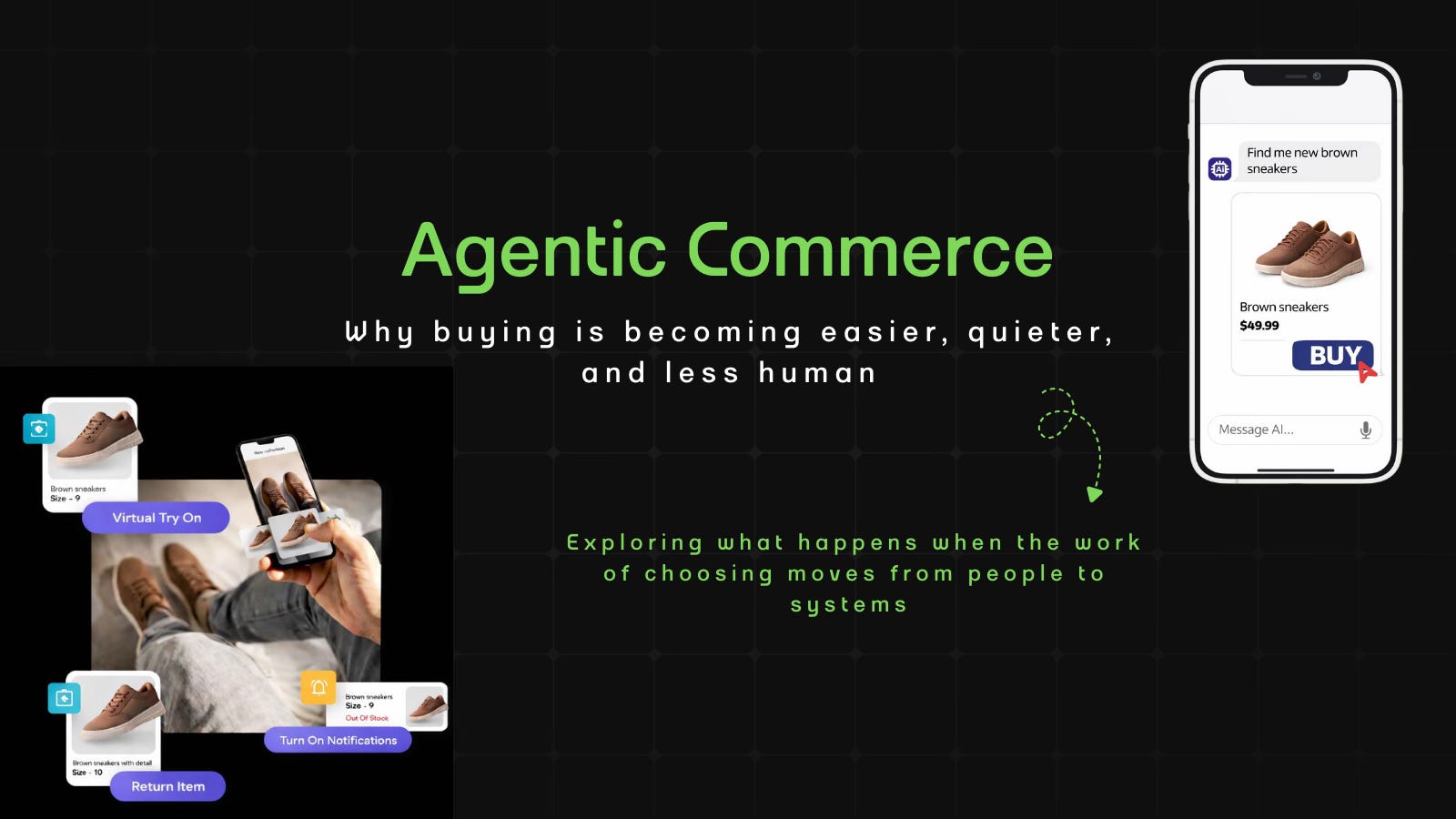
Some shifts in AI arrive with big product launches and louder promises. Others slip in quietly, reshaping habits we already take for granted. This week’s shift sits inside shopping, something most of us do routinely, often without much thought. It’s starting to move the work of choosing, comparing, and deciding away from people and into systems acting on their behalf.
This edition is a little different. Once a month, we pause the weekly roundups and focus on one defining shift in AI, unpacking it with a little more depth and clarity.
In Perspective: This week, we’re looking at agentic commerce and what happens when buying shifts from something we actively do to something we delegate. As checkout moves into chat interfaces and agents start narrowing choices for us, commerce becomes easier, quieter, and more controlled by systems than people.
It’s a fitting place to pause and reflect as the year comes to a close.
Shopping used to be a physical experience.
You went to stores. You walked through aisles. You touched things. You tried them on. You waited your turn. You compared options by moving from one rack to another. Sometimes you enjoy it. Sometimes you don’t. But you were present the entire time.
Choosing took effort, but it also felt real.
When shopping moved online, that experience changed.
Suddenly, everything was available on one screen. More options than any store could ever hold. You could shop from home, at any time, without travelling or standing in queues. On the surface, it felt easier.
But that abundance came with a trade-off.
With so many options, choosing started to take longer. You opened more tabs. You read more reviews. You went back and forth, unsure if the next option might be better. Delivery meant waiting. Returns meant more waiting. Trying something on often meant ordering first and dealing with the outcome later.
Online shopping removed physical effort, but it replaced it with mental effort.
So the industry spent the next decade trying to reduce that load.
Delivery got faster. Prime, same-day, next-day, scheduled slots. Returns got easier, at least on paper. Interfaces improved. Reviews became richer. Filters got more granular. Size charts, fit prediction, AR try-ons, and comparison tables tried to answer questions before you had to ask them. One-click checkout and saved payment details removed friction at the end of the journey.
What we were doing in physical stores was slowly recreated online, step by step, inside a single app.
The experience improved. Shopping became easier, faster, and more predictable.
But even after all of this, one thing stayed the same.
You still had to do the work of choosing.
You still had to explore options, compare trade-offs, and decide when something was “good enough.” Convenience helped, but it didn’t remove the responsibility of choice. It only made the process more manageable.
That is the point where AI enters the story.
What agentic commerce actually is
Agentic commerce is not “better recommendations.” It is not “chat-based shopping.” It is a shift in who performs the work of shopping.
Instead of you discovering, comparing, and narrowing down, an agent does it for you. You provide intent and constraints. The agent turns that into actions: search, evaluate, shortlist, and sometimes purchase.
The easiest way to see the shift is to look at what OpenAI, Shopify, and Stripe launched in late 2025.
OpenAI introduced Instant Checkout in ChatGPT and the Agentic Commerce Protocol (ACP) as “first steps toward agentic commerce.” Stripe announced it was powering Instant Checkout and co-developing ACP as an open standard to connect agents, people, and businesses for purchases.
Then Shopify made the point unmissable: Shopify merchants will be able to sell directly through ChatGPT conversations, no links or redirects.
This is the clearest “line in the sand” so far: commerce does not have to end on a storefront. It can end inside the agent interface.
And once the interface becomes the agent, the traditional shopping journey starts to collapse.
Where it stands now
Right now, agentic commerce is real, but uneven.
Most deployments sit in one of three buckets:
Discovery and advice inside an app
Amazon’s Rufus is a good example. It sits within Amazon’s app, answers shopping questions, compares products, and recommends options using Amazon’s catalog and web data. It’s not autonomous buying, but it makes conversation a primary layer of shopping.
Delegation for support and post-purchase tasks
Klarna’s AI assistant began with refunds, cancellations, and disputes and now handles a large share of customer interactions. That matters because returns and refunds are where trust in commerce is won or lost.
Early transactional agents that trigger platform conflict
As we discussed in one of our previous deep-dive editions on agentic browsing, the Amazon vs Perplexity conflict is one of the clearest early signals of what happens when agents start acting on a user’s behalf instead of just assisting them. What looked like a policy or security dispute was really about control. Who owns the journey when an agent decides what to click, what to skip, and what to buy.
That same tension shows up even more sharply in agentic commerce.
So yes, we are early.
But we are past the toy phase.
What gets better for people
Agentic commerce will feel like progress in the places where shopping is not identity, it is maintenance.
Groceries. Household basics. Replacement parts. The “I need it by Friday and I don’t care about browsing” category.
The benefits are straightforward:
It reduces the small tax of modern life. Fewer tabs. Less comparison. Less second-guessing.
It handles constraints better than humans do when we’re tired.
“Under $X.” “Delivers this week.” “Easy returns.” “Reliable seller.”
It improves continuity.
Agents can remember what you returned, what you complained about, what you re-ordered, and what you never want again.
This is why the most convincing agentic commerce examples are not “buy me a luxury handbag.” They’re “help me run my household.”
Amazon is already pushing this behaviour through voice too. The Verge reported Alexa Plus features that can monitor prices and even auto-purchase when a price drops below a user-set threshold. That is a clear example of “shopping becomes a background process.”
What gets worse for people
The cost is not money first. The cost is agency and variety.
Agentic commerce narrows the world before you see it. That sounds like a feature until you realise that browsing is how people discover taste, learn alternatives, and form preferences.
The biggest risk is not that agents make bad decisions. It’s that they make decisions that are “fine” so often that you stop noticing what you are not seeing.
At that point, you’re no longer choosing.
You’re approving.
Three problems show up fast as this becomes mainstream:
Opacity: If an agent recommends one option, why that one. Price? Margin? Reliability? Sponsored preference? Training bias? Or Partnership incentives? In a marketplace, ads are visible. With an agent, influence mostly stays invisible.
Mistakes with confidence: The more autonomous the agent, the more dangerous errors become. Wrong size is annoying. Wrong delivery address is a mess. The wrong seller can become a fraud problem. Commerce isn’t forgiving because it becomes physical.
Consent boundaries: Where does “help me find” end and “go ahead and buy” begin. That boundary needs guardrails, and right now those guardrails are inconsistent across products.
For example, buying clothes has always been about more than the item itself.
You might start with a clear need, but along the way you notice a different cut, a colour you hadn’t considered, a brand you didn’t know before. You compare how things look, not just how they perform. You change your mind halfway through.
An agent doesn’t do that.
If you ask for “a black dress for a wedding under $8,000 that is delivered this week,” you’ll get a sensible shortlist. But you won’t see the bright option that catches your eye. You won’t stumble onto a silhouette you didn’t know you liked. You’ll get something appropriate, not surprising.
The purchase will work.
But the experience will be thinner.
This is the quiet trade-off.
What it means for platforms
Agentic commerce attacks the foundation of large marketplace platforms, where ads, rankings, and merchandising shape what gets seen and bought.
Marketplaces like Amazon, DoorDash, and delivery aggregators don’t just earn money from transactions. They earn money from shaping choices before checkout. Ads, rankings, bundles, cross-sells, and sponsored placements exist because humans browse and linger.
Agents don’t linger.
When an agent becomes the interface, those surfaces lose power. The platform risks becoming an inventory backend rather than a decision shaper.
That’s why platform responses are predictable. Build their own agents. Restrict third-party agents. Redesign monetisation so agents, not humans, are the audience.
The Amazon–Perplexity fight wasn’t about one tool. It was about who owns the journey.
What this means for vendors and storefronts
So far, we’ve looked at agentic commerce from the buyer’s side. But the shift is just as meaningful on the other end of the transaction.
For vendors, agentic commerce quietly changes what a storefront is optimised for.
Traditionally, storefronts were built to influence humans. Layouts, imagery, copy, reviews, bundles, and nudges all existed to shape attention and guide choice. Browsing time mattered. Storytelling mattered. Even friction sometimes helped.
Agents don’t engage with storefronts that way.
When the buyer is a system, persuasion takes a back seat to clarity. What matters most is whether the product can be clearly understood, compared, and trusted without human interpretation. Clean attributes matter more than clever copy. Consistent pricing and delivery promises matter more than visual polish. Edge cases and vague policies become liabilities.
You can already see major storefront and payment platforms adjusting to this reality.
Shopify’s move to enable direct checkout inside ChatGPT is a clear signal. It’s not just about adding another sales channel. It’s about making Shopify-powered catalogs, pricing, and checkout callable by agents, without forcing the user through a traditional storefront. The store becomes the infrastructure, not the destination.
Stripe is approaching the same shift from the payments layer. With APIs designed for programmatic checkout and standards like the ACP, Stripe is positioning itself as the execution layer agents can rely on. The emphasis isn’t UI. It’s reliability, compliance, and safe automation.
PayPal and similar payment platforms are experimenting in a quieter way. Their focus is less on discovery and more on making authorization, identity, and trust portable across agent-driven flows.
And for commerce platforms like Fynd, this shift is even more structural. Unified catalogs, real-time inventory, order management, logistics, and policy enforcement aren’t just conveniences anymore. They’re prerequisites. Agents can only act when the underlying system reflects reality accurately. In that sense, Fynd and similar platforms are already closer to being agent-ready than many storefront-first tools.
This creates a real shift for teams building commerce products.
Instead of asking “how do we get users to explore more?”, the question becomes “can an agent reliably evaluate us?”
Can it understand our variants?
Can it predict fulfillment accurately?
Can it trust our return and refund logic?
For vendors with strong operations, this can be a positive change. Agents tend to reward reliability. Products that consistently deliver what they promise are more likely to surface, even without heavy brand spend. In that sense, agentic commerce can level parts of the playing field.
But there are risks too.
Agents optimize for predictability. That means newer brands, unconventional products, or anything that requires explanation can struggle to appear. Discovery narrows. Novelty gets filtered out early. Over time, this can quietly flatten marketplaces.
There’s also a loss of visibility.
When decisions happen inside agents, vendors may no longer know why they were shortlisted or excluded. A change in an agent’s logic, partnership, or ranking signal can impact sales without clear feedback. For storefront teams, debugging performance becomes harder when the “user” never actually sees the page.
The role of the storefront shifts as a result.
It becomes less about persuasion and more about being a source of truth. Less about telling a story, more about representing reality accurately enough for a system to decide. Storytelling doesn’t disappear, but it moves elsewhere. At the point of transaction, clarity beats charisma.
For vendors and commerce platforms, this is not a cosmetic change. It’s a structural one. The better your systems reflect how your business actually operates, the better agents can work with you.
What it means for brands and merchants
For merchants, this can be both a gift and a threat.
It’s a gift because agents can reward true performance: clean product data, fewer returns, reliable fulfilment, real availability. When the buyer is a system, sloppy operations become a liability faster.
It’s a threat because discovery becomes a gatekeeper problem. Instead of “how do I rank on Amazon,” it becomes “how do I get shortlisted by the agent.”
Shopify’s OpenAI partnership is exciting precisely because it gives merchants a new surface: selling directly in ChatGPT conversations. But it also makes the new competition obvious: you’re now competing inside an interface where the agent decides what’s shown first, and the user may never scroll beyond the shortlist.
What brands will do next
Brands won’t sit still. Agentic commerce forces changes not just in tactics, but in how brands choose vendors, platforms, and even how they think about their own stacks.
The first shift is structural.
Brands will invest heavily in machine-readable truth. Structured attributes, accurate inventory, delivery promises, return rules, compatibility data, and policy clarity stop being “backend hygiene” and start becoming growth levers. If an agent can’t reliably understand a product, it simply won’t surface it.
This alone changes how brands evaluate commerce platforms.
Instead of asking, “Does this storefront look good?” or “Does this tool help with conversions?”, brands will ask:
Can this platform expose my catalog cleanly to agents?
Can it guarantee real-time inventory and fulfilment signals?
Can it execute orders, refunds, and changes programmatically without breaking?
Platforms that can’t support agent-readable catalogs, programmatic checkout, and reliable post-purchase flows will slowly fall out of favour, even if they perform well today for human shoppers.
The second shift is optimization for agents, not people.
Just as SEO reshaped content for search engines, we’ll see the rise of agent optimisation. Brands will start asking different questions. How often do we get shortlisted? What signals get us dropped. What does “reliable” mean to this agent?
This pushes brands toward platforms and vendors that offer observability. If decisions are happening upstream, brands will need tools that explain why they were chosen or excluded. Black-box systems become risky when agents, not users, are making the call.
The third shift is in how brands think about differentiation.
In an agentic flow, storytelling at the point of purchase matters less. Brands will move narrative and emotional differentiation to other surfaces: social, community, content, creators. The commerce layer itself becomes more utilitarian. Clean, predictable, and optimized for execution.
This also affects build vs buy decisions.
Brands will be less interested in stitching together brittle point solutions and more interested in unified stacks that reduce ambiguity. Fewer integrations. Clearer primitives. Systems that reflect reality accurately, not optimistically. Reliability beats flexibility when an agent is doing the choosing.
Then monetisation re-enters.
Paid placement won’t disappear. It will move upstream. Preferred suppliers. Trusted partners. Agent-friendly defaults that never look like ads on a screen. Brands that understand this early will start budgeting for “agent surfaces” the same way they once budgeted for search or marketplaces.
The shelf moves again.
This time, it moves into systems most customers never see.
And for brands, the real challenge won’t be learning how to sell to people. It will be learning how to be legible, trustworthy, and competitive in a world where the buyer is no longer human.
All of these shifts on the brand side depend on something deeper. They only work if the underlying commerce platform is designed to support agent-driven interactions in the first place.
Which brings us to the role of platforms.
Where this leaves platforms like Fynd
Agentic commerce doesn’t mean platforms like Fynd need to reinvent themselves. If anything, it validates the direction they were already moving in.
Agents only work when the underlying commerce stack is solid. Product data needs to be structured. Inventory needs to be real-time. Pricing, orders, shipping, refunds, and policies need to be connected. Online, offline, and marketplace channels need to operate as one system.
That’s already the foundation of unified commerce.
The opportunity for Fynd Commerce isn’t to build an agent. It’s to be the system agents plug into. Agents don’t replace commerce stacks. They depend on them.
What does change is the interaction layer.
Discovery, comparison, and even checkout are moving into conversational surfaces. Control and fulfilment still sit with the merchant stack. For Fynd, this means treating conversation as a new channel and agents as a new kind of marketplace, similar to Amazon integrations, but agent-native.
Practically, that means catalogs need to be agent-readable. Pricing, availability, and delivery promises need to be queryable. Checkout needs to be executable programmatically, with clear guardrails. Pages matter less. Primitives matter more.
The most meaningful agentic opportunity, though, isn’t on the consumer front end.
It’s in the back office.
Merchants don’t just need help selling. They need help deciding. What to restock. What to discount. Why conversions dropped. Which SKUs are causing issues. This is where agents can deliver immediate value, and it’s where Fynd already has context across catalog, inventory, orders, and operations.
Customer support is another obvious wedge. Not FAQ bots, but agents that can actually act. “Where is my order?” answered with real status. “Change delivery address” executed. “Initiate refund” triggered. This is where agentic commerce becomes operational, not cosmetic.
All of this points to a subtle positioning shift.
Unified commerce was about giving humans one system to manage complexity. Agentic commerce is about making that system operable by humans and agents together. That brings new requirements: permissions, guardrails, auditability, and clear points for human override.
The next narrative isn’t “AI features.”
It’s commerce that agents can safely operate.
In that sense, Fynd Commerce isn’t competing to be the agent. It’s becoming the infrastructure that makes agentic commerce possible.
Security, fraud, and “agent abuse”
Once agents can transact, commerce becomes a security problem in a new way.
The risks include:
compromised agent accounts making purchases
prompt-injection style manipulation through web content
merchants being impersonated
“agentic arbitrage” and exploit patterns where agents behave predictably
OpenAI and Stripe are clearly aware of this. ACP is positioned as a secure, merchant-controlled protocol where merchants can accept/decline orders and maintain compliance signals. That is a sign that the industry expects fraud and misuse to shop up quickly.
We’re also already seeing how quickly trust collapses when AI touches pricing and fairness. Instacart just ended its AI-driven pricing experiments after criticism and regulatory scrutiny around inconsistent prices shown to different users for the same items.
That wasn’t “agent checkout.” But it shows the same truth: automation in commerce creates trust failures faster than it creates delight.
When does this become “normal”
Two things can be true at once:
we are early
the timeline is not far
The most realistic adoption path looks like this:
Now to 12 months: agent-led discovery and assisted checkout expands across large surfaces (ChatGPT checkout, platform assistants, retailer copilots). We’re already here.
12 to 24 months: routine purchasing becomes increasingly delegated: replenishment, subscriptions, repeat carts, price monitoring, and “buy again” flows become agent-driven defaults (especially in voice and chat interfaces). Alexa auto-purchase is an early form of this.
24 to 48 months: more meaningful autonomy arrives, but with guardrails: approvals, spending limits, merchant accept/decline, auditable logs. B2B also accelerates because procurement is already structured and rule-driven. Forrester predicts agent-led quote negotiations will force a meaningful share of B2B sellers to engage.
I wouldn’t claim “complete autonomy everywhere” on a date. The limiting factor is not model capability. It’s trust, fraud, regulation, and who accepts liability.
My take
Agentic commerce will win where shopping is a chore.
But if we let the same logic dominate expressive categories, commerce becomes narrower and more homogenised. The “fun” of exploring is not just an activity or burden. It’s how people discover alternatives, develop taste, and avoid becoming trapped in defaults. Think about how often people find products on Instagram not because they searched for them, but because something caught their eye while scrolling.
The biggest danger is silent narrowing. Not bad outcomes, but repeated acceptable ones.
The most important design problem in agentic commerce is not checkout. It’s the moment where the agent needs to step back and let the human explore again.
If we get that right, agentic commerce becomes a powerful assistant.
If we get it wrong, it becomes a quiet gatekeeper.
In the Spotlight
Recommended watch: The Agentic Commerce Revolution is here - but it’s not what you think! (Brex CEO Pedro Franceschi)
I found this episode really interesting because it frames agentic commerce in the most practical way I’ve heard so far. Instead of treating it like “AI shopping,” Pedro explains it as orchestration. In B2B, buying isn’t one decision. It’s a chain of policies, approvals, procurement checks, security reviews, and accounting work that happens before and after the swipe. His point is simple: agents don’t just help you choose, they can absorb the messy coordination that makes corporate spend slow and painful. It also makes a strong case that the real opportunity is in B2B, where the complexity is higher and the ROI is easier to justify.
There’s 1.8 trillion corporate cards spent in the US today.
– Pedro Franceschi, Brex CEO • ~0:16
Closing Notes
That’s it for this edition of AI Fyndings. From shopping moving from exploration to delegation, to agents beginning to narrow choices before we ever see them, to platforms and brands adapting to a world where systems increasingly decide what counts as “best,” this week was about commerce quietly shifting out of our hands and into the logic of machines.
Thank you for reading, and happy holidays! See you next week with more stories, tools, and ideas shaping how AI continues to redefine how we build, choose, and live with technology.
With love,
Elena Gracia
AI Marketer, Fynd